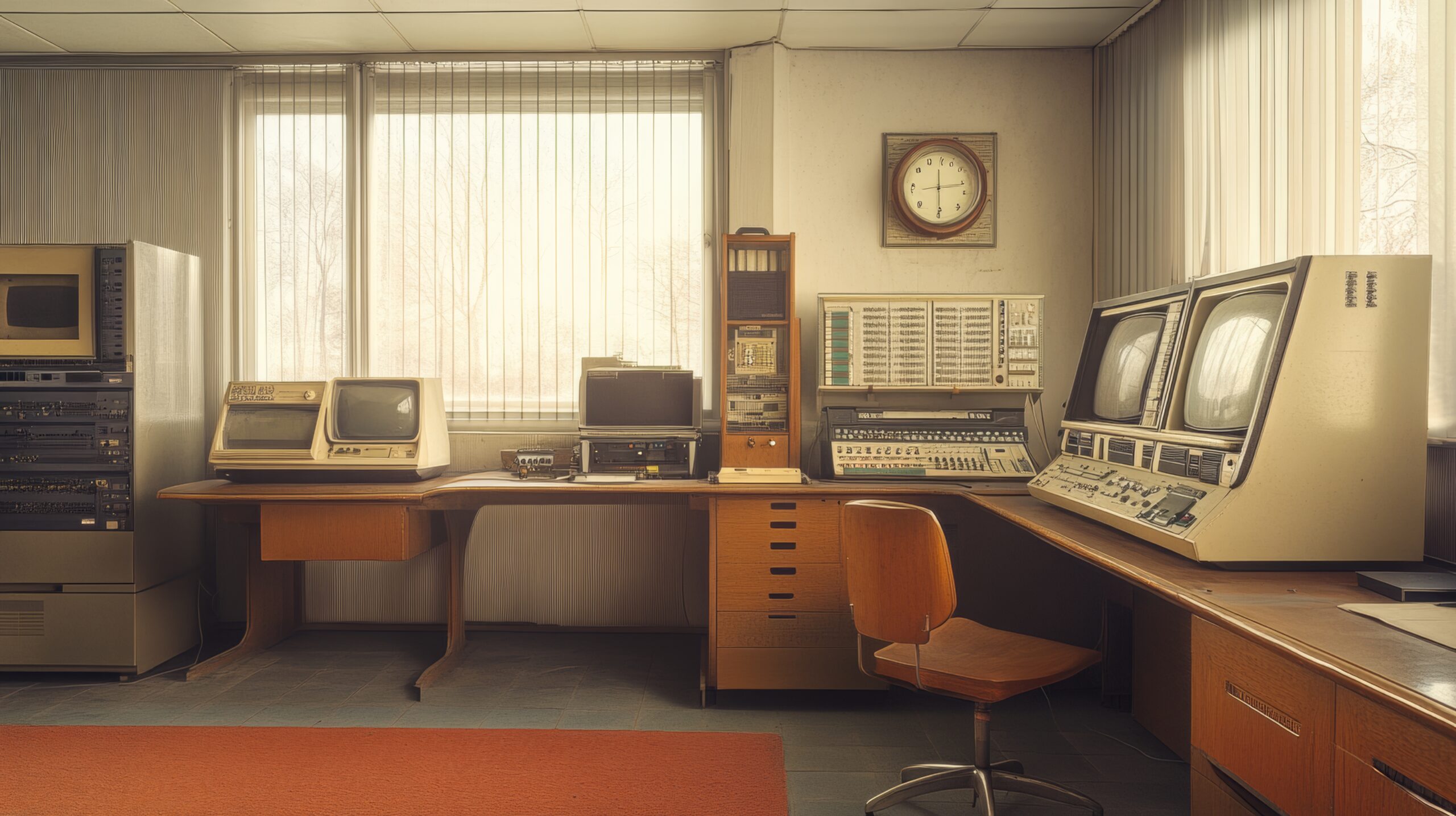
TL;DR: Artificial intelligence didn’t appear overnight. Its story spans over 70 years, from a 1952 checkers-playing program to the ChatGPT moment that changed how the world thinks about machines. Along the way there were false starts, funding crises, and genuine breakthroughs. This is the real history of AI, told plainly and honestly.
Somewhere in a university archive, there’s a reel of magnetic tape containing a program written in 1952 that could improve its own performance by playing games against itself. Most people have never heard of it. Yet that unremarkable-looking tape marks one of the most significant moments in human history: the birth of a machine that could learn.
The history of artificial intelligence is not a straight line from simple to sophisticated. It’s a story of wild ambition, crushing disappointment, patient rebuilding… And then, suddenly, a revolution that nobody quite saw coming.
1950: The Question That Started Everything
The story begins with a British mathematician named Alan Turing. In 1950, he published a paper titled Computing Machinery and Intelligence and opened it with a deceptively simple question: “Can machines think?”
To answer it, he proposed what he called the Imitation Game, now universally known as the Turing Test. A human judge holds a text conversation with both a human and a machine. If the judge cannot reliably tell which is which, the machine has demonstrated something meaningfully like intelligence.
Turing never claimed to have built a thinking machine. He was asking whether it was even possible. But by posing the question rigorously, he gave an entire field its founding challenge.
1952–1956: The First Steps
Two years after Turing’s paper, an IBM engineer named Arthur Samuel wrote the world’s first program that could be called artificially intelligent. His checkers-playing program didn’t just follow rules, it played games against itself and adjusted its strategy based on what worked. It improved over time without anyone rewriting it.
This was, in the most literal sense, a machine learning from experience. The concept was born.
In 1956, the term artificial intelligence was formally coined. A group of mathematicians and scientists gathered for a summer workshop at Dartmouth College in New Hampshire, organised by a young researcher named John McCarthy. The proposal was bold: “Every aspect of learning or every other feature of intelligence can in principle be so precisely described that a machine can be made to simulate it.”
The Dartmouth Conference is widely regarded as the founding moment of AI as a formal field of study. The attendees, including McCarthy, Marvin Minsky, Claude Shannon, and Herbert Simon, would go on to define the discipline for decades.
The 1960s: Early Optimism (and Overconfidence)
The years that followed were electric with possibility. Researchers built programs that could solve algebra problems, prove geometric theorems, and hold rudimentary conversations. In 1966, a program called ELIZA was created at MIT by Joseph Weizenbaum. It mimicked a therapist by reflecting questions back at users. It was a parlour trick, the program understood nothing, yet users formed genuine emotional connections to it. Weizenbaum was disturbed enough by this response that he spent years afterward warning about the dangers of over-trusting machines.
Governments poured money in. Researchers made confident predictions. The US Defence Advanced Research Projects Agency (DARPA) funded labs handsomely on the expectation that human-level AI was a decade or two away.
It wasn’t.
The First AI Winter: 1974–1980
By the early 1970s, the gap between ambition and reality had become impossible to ignore. The problems researchers had dismissed as “nearly solved” turned out to be extraordinarily hard. Language was harder than expected. Vision was harder. Reasoning was harder. Computers simply weren’t powerful enough, and the mathematical tools available weren’t up to the task.
Funding dried up. Labs closed. The period became known as the first AI winter, a phrase that captured both the cold reality and the hope that spring would eventually return.
A 1973 report by mathematician Sir James Lighthill, commissioned by the British government, was particularly damaging. It concluded that AI had failed to live up to its promises in every area it had targeted and recommended that most AI research funding be cut. Britain largely pulled out of the field.
The 1980s: Expert Systems and a Second Spring
The 1980s brought a revival, this time built on a different idea: instead of trying to make machines learn from scratch, why not load them with human expertise?
Expert systems were programs built on thousands of hand-coded rules: “If the patient has these symptoms, consider these diagnoses.” Companies invested heavily. A system called XCON was saving Digital Equipment Corporation $40 million a year by correctly configuring computer orders. Japan launched a billion-dollar “Fifth Generation Computer” project. The US and UK followed with their own funding initiatives.
But the optimism didn’t last. Expert systems were brittle, they worked brilliantly within their defined rules and collapsed the moment they encountered anything outside them. Maintaining the rule libraries was expensive and exhausting. The market for AI hardware collapsed in 1987.
The second AI winter had arrived.
1997: A Chess Match That Changed Everything
In May 1997, an IBM supercomputer called Deep Blue defeated the reigning world chess champion, Garry Kasparov, in a six-game match. It was the first time a machine had beaten a sitting world champion under standard tournament conditions.
The match made front pages around the world. Kasparov alleged that some of Deep Blue’s moves were too creative to have been machine-generated and accused IBM of cheating (IBM denied it). Whatever the truth, the moment lodged itself in the public imagination as a turning point.
But Deep Blue wasn’t learning, it was searching. It evaluated 200 million positions per second using brute force and hand-coded chess knowledge. It was reactive AI at its most impressive, but it had no ability to transfer its skills to anything else.
2006–2012: The Deep Learning Revolution Begins Quietly
While the chess match captured headlines, the most important development was happening quietly in academic labs. A Canadian researcher named Geoffrey Hinton had spent years working on neural networks, computational systems loosely inspired by the human brain at a time when most of the field had abandoned them as impractical.
In 2006, Hinton published a paper showing how to train deep neural networks effectively. Few paid much attention. But he and a small group of collaborators — including Yann LeCun and Yoshua Bengio, now known as the “Godfathers of Deep Learning”, kept working.
Then came 2012, and everything changed.
A team from the University of Toronto entered the annual ImageNet competition, a challenge to correctly identify objects in images. Their system, called AlexNet, was powered by a deep neural network running on graphics processing units (GPUs). It didn’t just win; it cut the error rate nearly in half compared to the next best entry.
The result was so decisive that the entire field of AI pivoted almost overnight. Within two years, every major technology company was hiring deep learning researchers. The modern AI era had begun.
2016: AlphaGo and the Moment the World Sat Up
Chess had been conquered in 1997. But the ancient board game Go was considered a different matter entirely, far too complex, too intuitive, for machines to master any time soon. Go has more possible board configurations than there are atoms in the observable universe.
In March 2016, Google DeepMind’s AlphaGo defeated Lee Sedol, one of the greatest Go players of all time, four games to one. Unlike Deep Blue, AlphaGo had learned to play by studying millions of human games and then playing against itself millions of times more. One of its winning moves, Move 37 in Game 2, was so unexpected that experienced commentators initially assumed it was a mistake. It turned out to be a stroke of genius.
The AlphaGo match was a watershed. Experts had predicted this milestone was a decade away. It happened years ahead of schedule.
2017: The Paper That Powers Everything
In 2017, a team of Google researchers published a paper titled Attention Is All You Need. It introduced the Transformer architecture, a new way of building neural networks that proved extraordinarily powerful for understanding and generating language.
Almost every major AI system you use today, ChatGPT, Gemini, Claude, is built on the foundation that paper laid. It was the quiet revolution that made the loud revolution possible.
2022–Present: The ChatGPT Moment and Beyond
In November 2022, OpenAI released ChatGPT to the public. Within five days, it had one million users. Within two months, 100 million, making it the fastest-growing consumer application in history.
For the first time, millions of ordinary people could hold a conversation with an AI that felt genuinely intelligent. It could write code, draft emails, explain complex topics and pass professional exams. It wasn’t perfect, it hallucinated, it had blind spots, it could be confidently wrong. But it was remarkable enough to change what people believed was possible.
What followed was a full-scale race. Google released Gemini. Meta opened up its Llama models. Anthropic launched Claude. Governments began drafting legislation. The European Union passed the EU AI Act in 2024, the world’s first comprehensive AI regulation.
By 2026, AI is embedded in healthcare, law, education, finance, creative work and scientific research in ways that would have seemed fantastical just a decade ago.
What Comes Next?
The question the field is now grappling with is AGI: Artificial General Intelligence: a system that can do anything a human can, across any domain, without retraining. Nobody knows when or whether it will arrive. Estimates range from a few years to a few decades to never.
What’s certain is that the pace of progress has surprised almost everyone who has tried to predict it. The researchers who built ELIZA in 1966 could not have imagined ChatGPT. The team that trained AlexNet in 2012 did not anticipate GPT-4.
The history of AI is a lesson in not underestimating what patient, determined people with better tools can do.
Frequently Asked Questions About the History of AI
When was artificial intelligence invented? The term “artificial intelligence” was coined in 1956 at the Dartmouth Conference. But the foundational ideas, including Alan Turing’s concept of a thinking machine and Arthur Samuel’s self-learning program, date to the early 1950s.
What is an AI winter? An AI winter is a period of reduced funding and interest in AI research, typically following a wave of hype that outpaced what the technology could actually deliver. There were two major AI winters: the first in the mid-1970s and the second in the late 1980s.
Who invented artificial intelligence? No single person invented AI. John McCarthy coined the term and organised the 1956 Dartmouth Conference. Alan Turing laid the theoretical groundwork. Arthur Samuel created the first learning program. Geoffrey Hinton, Yann LeCun, and Yoshua Bengio pioneered the deep learning techniques that power modern AI.
What was the biggest turning point in AI history? Most researchers point to 2012 when the AlexNet deep learning system won the ImageNet competition by a stunning margin, as the moment that triggered the modern AI revolution.
Is AI getting smarter every year? Progress has not been linear, but since 2012 the rate of advancement has been remarkably consistent. Today’s AI systems can do things that seemed impossible a decade ago and the investment flowing into the field suggests that pace is unlikely to slow anytime soon.
Key Milestones at a Glance
| Year | Milestone |
|---|---|
| 1950 | Alan Turing publishes “Computing Machinery and Intelligence” |
| 1952 | Arthur Samuel builds the first self-learning program |
| 1956 | Dartmouth Conference, the term “artificial intelligence” is coined |
| 1966 | ELIZA chatbot created at MIT |
| 1974–80 | First AI winter, funding cuts, broken promises |
| 1987–93 | Second AI winter, expert systems collapse |
| 1997 | Deep Blue defeats world chess champion Garry Kasparov |
| 2006 | Geoffrey Hinton publishes landmark deep learning paper |
| 2012 | AlexNet wins ImageNet, the modern AI era begins |
| 2016 | AlphaGo defeats Lee Sedol at Go |
| 2017 | Transformer architecture introduced (“Attention Is All You Need”) |
| 2022 | ChatGPT launches, 100 million users in 60 days |
| 2024 | EU AI Act becomes law |
Curious about what AI can actually do today? Start with our complete guide: What Is Artificial Intelligence? →