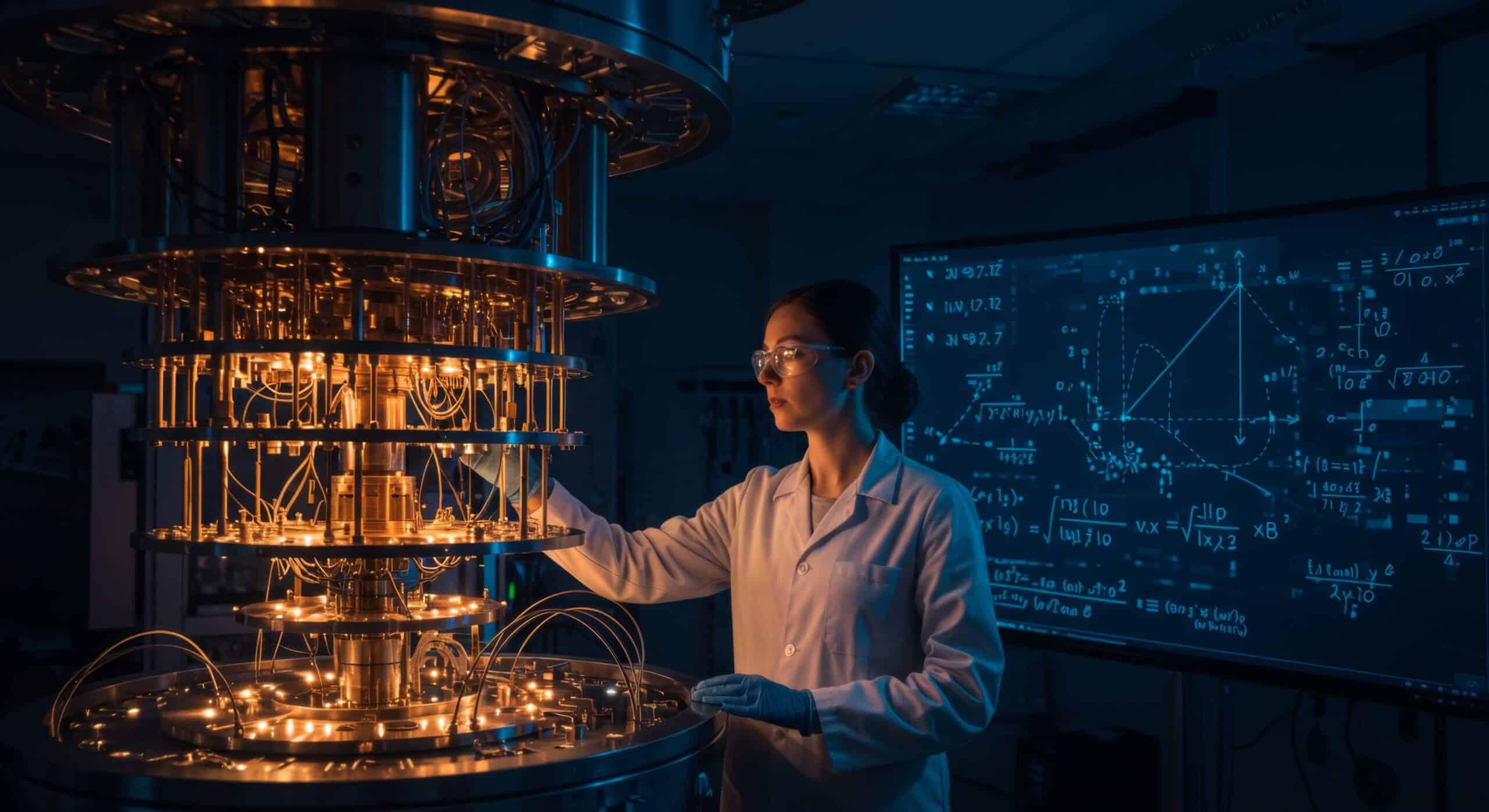
TL;DR: Quantum computing uses the laws of quantum physics, superposition, entanglement and interference to process information in ways classical computers fundamentally cannot. While today’s machines are still error-prone and experimental, real breakthroughs are happening in drug discovery, climate science, finance, and cryptography. Fault-tolerant, general-purpose quantum computers are roughly 5–15 years away, but the race to get there is accelerating fast.
Computers have transformed nearly every corner of modern life. But for all their power, today’s machines; from the phone in your pocket to the servers running the internet, are built on a foundation that’s nearly 80 years old. They process everything in ones and zeros, one instruction at a time. For most tasks, that’s perfectly fine. But for some of the biggest challenges facing humanity, simulating new medicines, modelling climate systems, cracking complex optimisation problems, classical computing simply hits a wall.
That’s where quantum computing comes in. It’s not just a faster computer. It’s a fundamentally different approach to processing information, one that draws on the strange rules of quantum physics to tackle problems no ordinary machine ever could.
What Makes a Quantum Computer Different From a Classical One?
To understand quantum computing, start with the classical computer’s basic unit: the bit. A bit is always either 0 or 1, like a light switch that’s either on or off.
A quantum computer uses qubits (quantum bits) instead. Thanks to a phenomenon called superposition, a qubit can be 0 and 1 simultaneously, until you measure it, at which point it “collapses” into one definite state. Think of a spinning coin: while it’s in the air, it’s neither heads nor tails. The moment it lands, you get your answer.
This might sound like a physics curiosity, but the implications are enormous. A classical computer with 3 bits can represent one of 8 possible combinations at a time. A 3-qubit quantum computer can represent all 8 simultaneously. Scale that up to 300 qubits and you can hold more states at once than there are atoms in the observable universe.
Two more quantum properties push this even further:
- Entanglement: Two qubits can be linked so that the state of one instantly influences the other, regardless of distance. This lets quantum computers coordinate information across many qubits in ways classical machines can’t replicate.
- Interference: Quantum algorithms can amplify paths leading to correct answers and cancel out paths leading to wrong ones, like noise-cancelling headphones, but for computation.
Together, these properties allow a quantum computer to explore vast solution spaces simultaneously and zero in on the right answer with extraordinary efficiency.
Where Does Quantum Computing Stand Today?
Quantum computing is no longer science fiction. It’s a rapidly maturing field backed by serious investment from governments, tech giants, and well-funded startups.
IBM has been one of the most transparent players, offering cloud-based access to real quantum processors and steadily growing qubit counts. In 2023, they unveiled a 1,121-qubit processor and have published roadmaps targeting genuine quantum advantage, the point where a quantum computer outperforms any classical machine on a useful, real-world problem.
Google made waves in 2019 claiming quantum supremacy after completing a calculation in 200 seconds that it said would take a supercomputer 10,000 years. The claim was contested, but it marked a watershed moment. In late 2024, Google unveiled its Willow chip, announcing a major breakthrough in error correction; long considered the field’s hardest engineering problem.
Microsoft is pursuing a different path, betting on topological qubits, which are theoretically far more stable. Meanwhile, startups like IonQ, Quantinuum, and Rigetti are each taking distinct hardware approaches, from trapped ions to photonic systems.
The key obstacle right now is noise and decoherence. Qubits are extraordinarily fragile, a stray vibration or temperature fluctuation can cause them to lose their quantum state. Today’s hardware is classified as NISQ (Noisy Intermediate-Scale Quantum): powerful enough to be interesting, but not yet reliable enough for most critical tasks. Building truly fault-tolerant machines, ones that can detect and fix their own errors, is the central challenge the field is racing to solve.
What Are the Real-World Applications of Quantum Computing?
Even in its current experimental state, quantum computing is already delivering results in research settings. As hardware matures, the practical applications are expanding fast.
Drug discovery and healthcare: Designing a new drug requires modelling how molecules interact at the atomic level. Classical supercomputers can only approximate this. Quantum computers can simulate molecular behaviour with far greater accuracy, potentially cutting the time to bring new medicines to market from decades to years.
Climate and materials science: Better solar cells, batteries, and carbon capture materials require deep quantum-level chemistry. Simulating the nitrogen fixation process alone could unlock far more energy-efficient alternatives to the Haber-Bosch process, which currently consumes 1–2% of global energy.
Finance and optimisation: Banks and hedge funds are already investing in quantum research. Portfolio optimisation, derivative pricing, and fraud detection across billions of transactions are exactly the kind of complex, multi-variable problems where quantum algorithms like QAOA (Quantum Approximate Optimisation Algorithm) can eventually outperform classical methods.
Cryptography and the threat to it: A powerful enough quantum computer could break the RSA encryption that secures most internet traffic today, using an algorithm called Shor’s algorithm. This threat is real enough that NIST (the US National Institute of Standards and Technology) finalized a new set of post-quantum cryptography standards in 2024. Security experts warn of “harvest now, decrypt later” attacks, where adversaries collect encrypted data today and decrypt it once quantum hardware catches up.
What Is the Future of Quantum Computing?
Most researchers put fault-tolerant, general-purpose quantum computers roughly 5–15 years away, but the curve is steepening. Error correction is improving, qubit architectures are diversifying, and quantum-classical hybrid systems (which offload quantum-suited tasks to quantum processors while classical chips handle the rest) are already in use.
What makes quantum computing particularly significant is that it isn’t replacing classical computing, it’s expanding what’s computable. The hardest problems in science, medicine and logistics, problems that have stumped researchers for generations, may finally have a machine capable of cracking them.
We’re not there yet. But the progress is real and it’s accelerating.
Frequently Asked Questions About Quantum Computing
Q: Is quantum computing available today? A: Yes, in limited form. Companies like IBM and Google offer cloud-based access to real quantum processors. However, today’s machines are still noisy and error-prone, making them best suited to research rather than production workloads.
Q: Will quantum computers make current encryption useless? A: Eventually, a powerful enough quantum computer could break widely used encryption standards like RSA. That’s why NIST published post-quantum cryptography standards in 2024. Organisations are encouraged to begin migrating now, before quantum hardware reaches that threshold.
Q: How is quantum computing different from supercomputing? A: A supercomputer is an extremely fast classical computer, it still operates on bits (0s and 1s). A quantum computer uses qubits and quantum mechanics to process information in a fundamentally different way, making it uniquely suited to specific problem types rather than general speed.
Q: When will quantum computers be commercially viable? A: Most experts estimate 5–15 years for fault-tolerant, general-purpose machines. Narrow quantum advantage for specific tasks (drug simulation, optimisation) is likely closer, possibly within 3–5 years.
Q: Can I try quantum computing myself? A: Yes. IBM’s Quantum Experience platform offers free cloud access to real quantum hardware. No physics degree required, just curiosity and a willingness to learn basic quantum circuit concepts.
For the latest developments, follow IBM Research, Google Quantum AI, and the MIT Technology Review’s quantum coverage.